
- Assistant Professor
- Area of Expertise: Artificial Intelligence (AI) Protein Design, Structural & Synthetic Biology, Cell Signaling, Neurovascular Biology, Immunology & Microbiology
- Office Location: Biomedical Building (R402)
- Office Phone: +886-2-28267114
- Lab Phone: +886-2-28267000 ext 65621
- E-mail:taohsin.chang@nycu.edu.tw
- Personal Website:Under construction
- ORCID: https://orcid.org/0000-0001-7242-2585
Education
- Ph.D. in Clinical Medicine, University of Oxford, UK
- M.Sc. in Biochemical Sciences, National Taiwan University, TW
- B.Sc. in Plant Pathology & Chemistry (sub-major), National Chung Hsing University, TW
Professional Experience
- Assistant Professor, Institute of Microbiology and Immunology, National Yang Ming Chiao Tung University, TW (2026 – Present)
- Mentor, the Mentoring Program, Taiwanese American Association of Biotechnology (TAAB), US (2024 – Present)
- Principal Scientist, GlaxoSmithKline (GSK), US (2025 – 2026)
- Senior Scientist, Integer Bio, US (2024 – 2025)
- Research Specialist, Howard Hughes Medical Institute (HHMI), US (2020 – 2023)
- Human Frontier Science Program (HFSP) Long-Term Fellow, Johns Hopkins University School of Medicine, US (2017 – 2020)
- Postdoctoral Research Scientist, University of Oxford, UK (2015 – 2017)
- Research Assistant, Academia Sinica, TW (2007 – 2010)
Awards
– Yushan Young Fellow, Ministry of Education, TW (2026 – 2030)
– Human Frontier Science Program (HFSP) Long-Term Fellowship (2017 – 2020)
– Travel Grant Award, Annual Meeting of Biophysical Society, US (2016)
– Nuffield Department of Clinical Medicine (NDM) Graduate Research Prize, University of Oxford, UK (2015)
– Best Student Presentation Award, EMBO workshop on Wnt Signaling: Stem Cells, Development, and Disease, AU (2014)
– Clarendon Scholarship, Somerville College Scholarship, NDM Prize Studentship, University of Oxford, UK (2010-2014)
– Dean Award, National Taiwan University, TW (2006)
– Best Presentation Award, Annual Meeting of the Taiwan Society of Biochemistry and Molecular Biology, TW (2005)
– Ching O Medal Award, National Chung Hsing University, TW (2000)
Conference Chair / Organizer
– Co-organizer and committee, Taiwanese Life Science Association in the UK (2012)
Invited International Talks
– Director Special Seminar, National Eye Institute, NIH, US (2023)
– Human Frontier Science Program Awardees Meeting, FR (2021)
– American Crystallographic Association Annual Meeting, US (2020)
– British Biophysical Society Biennial Meeting, UK (2016)
Publications
- – Hillier, J., Zhao, Y., Carrique, L., Malinauskas, T., Ruza, R.R., Chang, T.H., Yi, G., Duyvesteyn. H., Yu, J., Lu, W., Pardon, E., Steyaert, J., Zhu, Y., Ni, T., and Jones, E.Y. (2024). Structural Insights into Frizzled3 through Nanobody Modulators. Nature Communications 15, 7228 DOI: 10.1038/s41467-024-51451-1
- – Zhu, N., Smallwood, P.M., Rattner, A., Chang, T.H., Williams, J., Wang, Y., and Nathans, J. (2024). Utility of protein-protein binding surfaces composed of anti-parallel alpha-helices and beta-sheets selected by phage display. Journal of Biological Chemistry 300, 107283. DOI: 10.1016/j.jbc.2024.107283
- – Chang, T.H.#, Hsieh, F.L., Gu, X., Smallwood, P.M., Kavran, M.J., Gabelli, S.B., and Nathans, J.# (2023). Structural insights into Plasmalemma Vesicle-Associated Protein (PLVAP): implications for vascular endothelial diaphragms and fenestrae. Proc Natl Acad Sci U S A 120, e2221103120 DOI: 10.1073/pnas.2221103120 #Co-corresponding author
- – Hsieh, F.L.*, Chang, T.H.*#, Gabelli, S.B., and Nathans, J.# (2023). Structure of Wnt inhibitor adenomatosis polyposis coli down-regulated 1 (APCDD1), a Cell-Surface Lipid-Binding Protein. Proc Natl Acad Sci U S A 120, e2217096120 DOI: 10.1073/pnas.2217096120 *Equal Contribution, #Co-corresponding author
- – Chang, T.H., Hsieh, F.L., Smallwood, P.M., Gabelli, S.B., and Nathans, J. (2020). Structure of the RECK CC domain, an evolutionary anomaly. Proc Natl Acad Sci USA 117, 15104-15111 DOI: 10.1073/pnas.2006332117
- – Chang, T.H., Hsieh, F.L., Zebisch, M., Harlos, K., Elegheert, J., and Jones, E.Y. (2015). Structure and functional properties of Norrin mimic Wnt for signalling with Frizzled4, Lrp5/6, and proteoglycan. eLife 4, e06554 DOI: 10.7554/elife.06554
- – Kakugawa, S.*, Langton, P.F.*, Zebisch, M.*, Howell, S.A., Chang, T.H., Liu, Y., Feizi, T., Bineva, G., O’Reilly, N., Snijders, A.P., Jones, E.Y., and Vincent, J.P. (2015). Notum deacylates Wnt proteins to suppress signalling activity. Nature 519, 187-192. *Equal Contribution DOI: 10.1038/nature14259
- – Chang, C.K., Teng, K.H., Lin, S.W., Chang, T.H., and Liang, P.H. (2013). Control activity of yeast geranylgeranyl diphosphate synthase from dimer interface through H-bonds and hydrophobic interaction. Biochemistry 52, 2783-2792. DOI: 10.1021/bi4001276
- – Chang, T.H.*, Chang, S.J.*, Hsieh, F.L., Ko, T.P., Lin, C.T., Ho, M.R., Wang, I., Hsu, S.T., Guo, R.T., Chang, W., and Wang, A.H. (2013). Crystal structure of vaccinia viral A27 protein reveals a novel structure critical for its function and complex formation with A26 protein. PLoS pathogens 9, e1003563. *Equal Contribution DOI: 10.1371/journal.ppat.1003563
- – Hsieh, F.L.*, Chang, T.H.*, Ko, T.P., and Wang, A.H. (2011). Structure and mechanism of an Arabidopsis medium/long-chain-length prenyl pyrophosphate synthase. Plant Physiology 155, 1079-1090. *Equal Contribution (Featured on Cover) DOI: 10.1104/pp.110.168799
- – Hsieh, F.L., Chang, T.H., Ko, T.P., and Wang, A.H. (2010). Enhanced specificity of mint geranyl pyrophosphate synthase by modifying the R-loop interactions. Journal of Molecular Biology 404, 859-873. DOI: 10.1016/j.jmb.2010.10.011
- – Chang, T.H.#, Hsieh, F.L., Ko, T.P., Teng, K.H., Liang, P.H., and Wang, A.H.# (2010). Structure of a heterotetrameric geranyl pyrophosphate synthase from mint (Mentha piperita) reveals intersubunit regulation. The Plant Cell 22, 454-467. #Co-corresponding author (Highlighted in A-IMBN research and Photon Factory science) DOI: 10.1105/tpc.109.071738
- – C, K.M.C.*, Hudock, M.P.*, Zhang, Y.*, Guo, R.T., Cao, R., No, J.H., Liang, P.H., Ko, T.P., Chang, T.H., Chang, S.C., Chang, Y., Axelson, J., Kumar, A., Wang, A.H. and Oldfield, E. (2008). Inhibition of geranylgeranyl diphosphate synthase by bisphosphonates: a crystallographic and computational investigation. Journal of Medicinal Chemistry 51, 5594-5607. *Equal Contribution DOI: 10.1021/jm800325y
- – Guo, R.T.*, Cao, R.*, Liang, P.H., Ko, T.P., Chang, T.H., Hudock, M.P., Jeng, W.Y., Chen, C.K., Zhang, Y., Song, Y., Kuo, C.J., Yin, F., Oldfield, E., and Wang, A.H. (2007). Bisphosphonates target multiple sites in both cis- and trans-prenyltransferases. Proc Natl Acad Sci USA 104, 10022-10027. *Equal Contribution DOI: 10.1073/pnas.0702254104
- – Chang, T.H., Guo, R.T., Ko, T.P., Wang, A.H., and Liang, P.H. (2006). Crystal structure of type-III geranylgeranyl pyrophosphate synthase from Saccharomyces cerevisiae and the mechanism of product chain length determination. Journal of Biological Chemistry 281, 14991-15000. (Highlighted in SPring-8 Research Frontiers) DOI: 10.1074/jbc.M512886200
Books:
– Hsieh, F.L.#, and Chang, T.H.# (2023). Antibody Display technology (ADbody) to present challenging and unstable target proteins on the antibodies. Methods in Molecular Biology (Genotype Phenotype Coupling 373-382) DOI: 10.1007/978-1-0716-3279-6_21 #Co-corresponding authors
Research Focus:
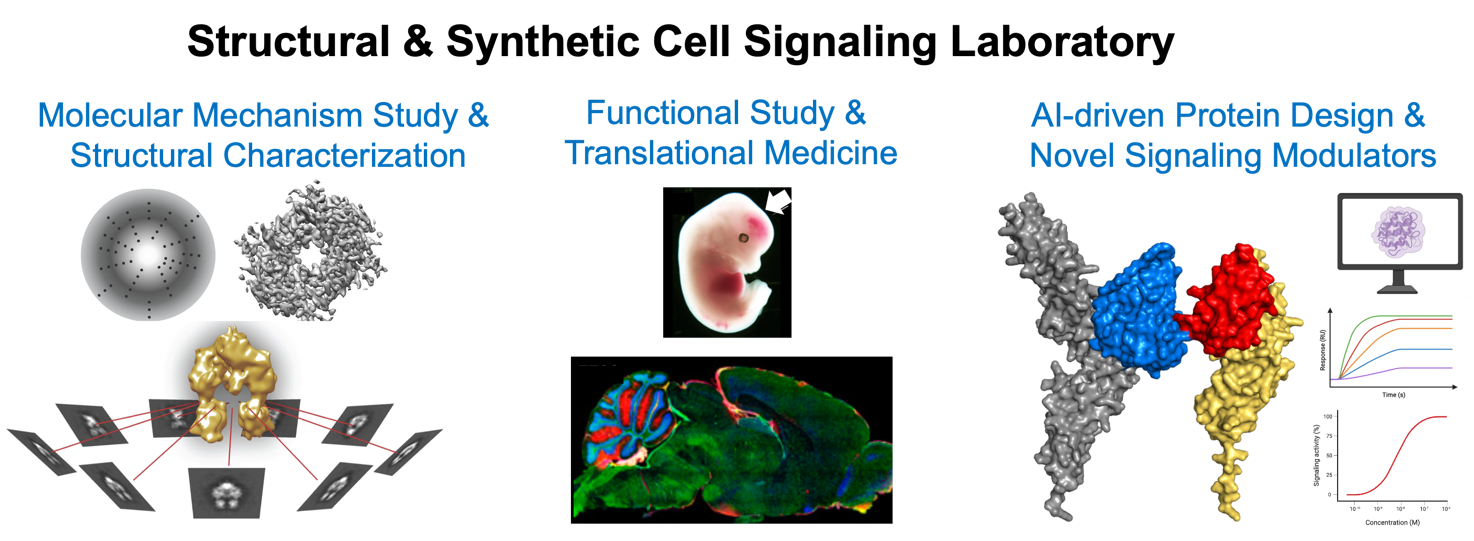
Structural & Synthetic Cell Signaling Laboratory
We bridge fundamental science and translational medicine to tackle major biomedical challenges. Our core mission is to decode, manipulate, and reprogram the cellular signaling networks that regulate human health and drive disease. Integrating structural biology (X-ray crystallography & Cryo-EM), cell biology, and AI-guided protein design, our multidisciplinary approach seeks to discover novel therapeutic avenues for cancer, vascular disorders, neurodegenerative conditions, and infectious diseases.
Our Key Research Directions
• Decoding Cellular Signaling: Uncovering how key signaling pathways control neurovascular development, immune defense, and tumorigenesis.
• Understanding Disease Mechanisms: Mapping out how faulty or dysregulated pathway signaling shifts cellular behavior from healthy to: pathological states.
• Engineering New Therapeutics: Harnessing AI and synthetic biology to design custom proteins capable of reprogramming cellular signals for clinical and scientific applications.
Lab Members:
Join Our Team
Are you interested in working with us? Applications are open to both domestic and international students. We welcome applicants from diverse backgrounds (both scientific and non-traditional).
Potential candidates are encouraged to reach out via email. Please include your CV and a short statement outlining your interest in our lab. Additional supporting documents (such as transcripts or a thesis) are welcome but not required.
We also encourage applications for other positions, including postdoctoral fellows and visiting scientists, particularly those who have or can secure external funding.
Current Lab Status
Our team is growing! An experienced Research Assistant and an established Postdoctoral Fellow will be joining the lab in early 2027.
Lab Photos: